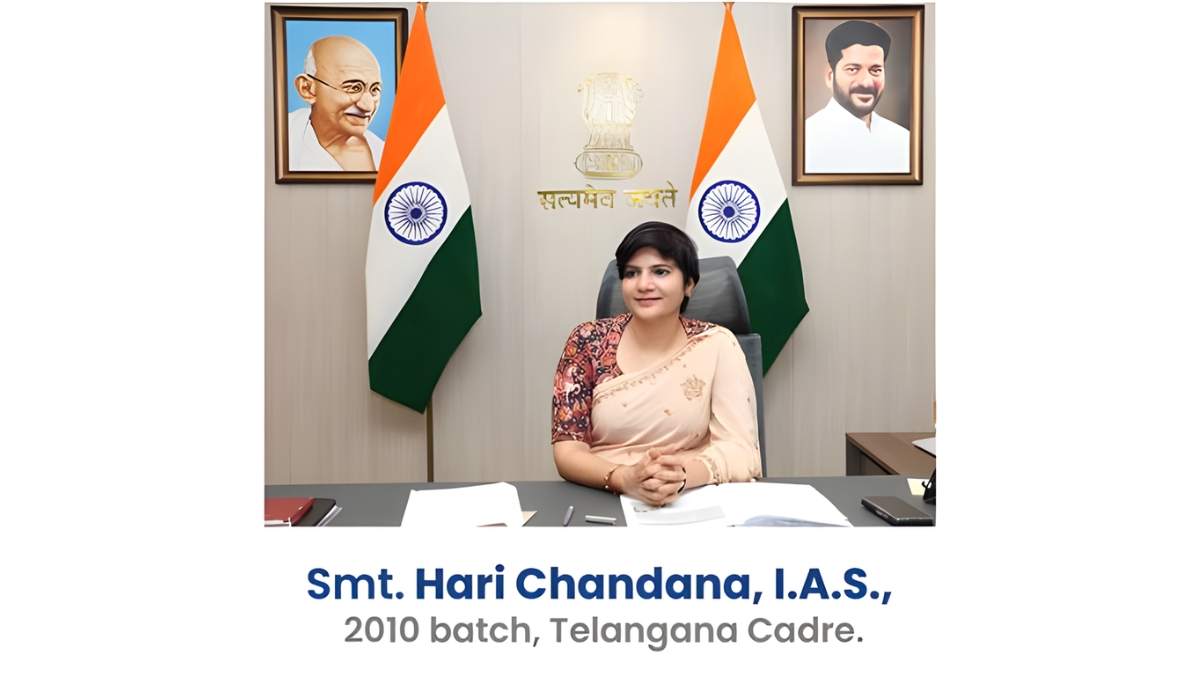
At the heart of this revival is Hari Chandana, whose administrative vision consistently integrates sustainability, culture, and community participation. The rejuvenation of the stepwell is not an isolated achievement, but part of a broader, ongoing legacy of heritage conservation across Telangana under her leadership.
This revival reflects the journey of an officer who has transformed neglected spaces into thriving public assets.
Urban Heritage Leadership: The GHMC Years
Before moving into district administration, Hari Chandana served as Zonal Commissioner at the Greater Hyderabad Municipal Corporation (GHMC), where sustainability and heritage preservation became integral to urban governance.
One of the most symbolic restoration projects of that period was the revival of the 17th-century Bansilalpet Stepwell, located in the old quarters of Hyderabad. Long buried under garbage and neglect, it was transformed from a waste-filled pit into a captivating heritage landmark.
Ancient stone steps were reopened, traditional architectural elements were restored, and the stepwell was reintroduced into public life as a cultural asset.
This transformation also reflected broader reforms within GHMC:
- Reclaiming historic public spaces
- Reviving traditional water structures
- Integrating sustainability into urban development
This urban heritage awakening laid the foundation for a wider stepwell revival movement later led in Narayanpet district.
District-Level Heritage Revival in Narayanpet
Upon becoming Collector of Narayanpet district, her vision unfolded at a larger scale — in a region rich with historic stepwells that had long been neglected.
Baram Baoli — Where Revival Began
One of the earliest major successes was the restoration of Baram Baoli, a centuries-old stepwell buried under debris and abandonment.
Under her leadership:
- Debris was cleared
- The original stone structure was conserved
- Community ownership was restored
The results were remarkable — festivals returned, families gathered again, and the stepwell reclaimed its role as both a water source and a social hub.
This was not merely restoration.
It was a rebirth of public life.
Rediscovering a Forgotten Network of Ancient Stepwells
The revival of Baram Baoli sparked a larger initiative.
Hari Chandana initiated the documentation and phased restoration of dozens of ancient stepwells across Narayanpet district — many of which had been forgotten for generations.
These were not cosmetic clean-up drives.
They focused on:
- Traditional conservation techniques
- Groundwater recharge
- Community stewardship
- Long-term sustainability
Gradually, the entire district reconnected with its forgotten water heritage. Structures once built centuries ago to combat drought are today strengthening climate resilience.
Local Leadership Aligned with Global Heritage Values
The significance of stepwells has been globally recognized by UNESCO, which regards traditional water systems as masterpieces of climate-responsive engineering and cultural architecture.
Across India, UNESCO-recognized heritage principles highlight that stepwells historically served as:
- Environmental infrastructure
- Social gathering spaces
- Architectural marvels
- Symbols of sustainable living
The conservation efforts led by Hari Chandana align with these global principles — safeguarding authenticity while restoring functionality and community relevance.
Mah Laqa Bai Stepwell — A Convergence of Vision
The experience gained from urban sustainability initiatives in GHMC and rural heritage revival in Narayanpet converged powerfully in the restoration of the Mah Laqa Bai Stepwell.
Here, heritage conservation became:
- Architectural restoration
- Groundwater sustainability
- An educational heritage space
- A platform for community collaboration
Today, it stands not as a static monument, but as a living symbol of Hyderabad’s past nourishing its future.
Redefining Development Through Heritage
What distinguishes Hari Chandana IAS is not merely the number of projects undertaken, but the philosophy behind them.
She has demonstrated that:
- Development does not require erasing history
- Heritage can drive sustainability
- Governance can reconnect people with their roots
In an era of rapid concrete expansion, her work proves that true progress preserves memory while building the future.
From City Streets to Ancient Stone Steps — A Flowing Legacy
From urban Hyderabad under GHMC…
To the rural stepwells of Narayanpet…
To the grand revival within Osmania University…
Hari Chandana’s journey represents a rare continuity of visionary public service.
Each restored stepwell sends a powerful message:
When leadership respects heritage,
the future becomes stronger.