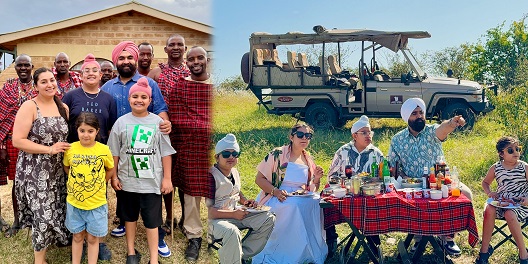
OLARE MOTOROGI, KENYA — In a landscape where lions rule and silence stretches wider than the savannah itself, a Sikh family of five found something far greater than just wildlife: connection, purpose, and a redefinition of luxury.
Renowned for their family-focused, values-driven travel storytelling, Harjinder Singh Kukreja and Harkirat Kaur Kukreja—joined by their three children, Rehras, Aad Sach, and Rut Suhavi—embarked on a soulful safari experience deep in Kenya’s Maasai lands. But instead of following the well-trodden path into the Maasai Mara National Reserve, they did what few do: they chose the road less travelled.
Their journey began at Porini Ol Kinyei Safari Cottages, nestled within the Ol Kinyei Conservancy—one of sixteen community-owned wildlife conservancies bordering the main reserve. Here, the Kukrejas checked into a four-bedroom exclusive-use lodge complete with a private chef, solar lighting, and panoramic savannah views. The conservancy, free from the traffic and tourist vans that sometimes crowd the national reserve, delivered an unfiltered experience of Kenya’s wild heart. Morning game drives revealed lion tracks; evenings ended with sundowners beside giraffes silhouetted by the pink dusk. The days flowed slowly and intentionally, guided by local Maasai naturalists who offered stories, not just sightings.
“Everything was raw, honest, and done with so much dignity,” said Harjinder Singh Kukreja, an acclaimed content creator and entrepreneur known for championing mindful travel. “We came to see the wild, but we left with a deeper love for the people who protect it.”
The second half of their trip took them to Porini Lion Camp in the Olare Motorogi Conservancy, a vast, 85-square-kilometre swathe of protected land that’s home to some of the densest lion populations in East Africa. Here, the family spread out into beautifully appointed en-suite tents, each overlooking a private watering hole. Game drives here were deeply personal, tailored, and filled with life—wildebeests on the move, cheetahs on the prowl, and the ever-playful antics of warthogs and zebras.
What tied both experiences together was the ethos behind them.
Both camps are part of Porini Camps, a trailblazing initiative by conservationist Mohanjeet Brar of Gamewatchers Safaris. Brar’s model is revolutionary in its simplicity and sincerity: land is leased from the Maasai, not taken. Local communities are not just included—they are central. Every stay directly funds schools, clinics, and conservation jobs. Rangers from the very villages that once struggled against poaching are now guardians of the wild.
“For us, conservation is not a side note—it’s the heart of everything,” said Mohanjeet Brar, Managing Director of Gamewatchers Safaris. “Tourism must give back. When families like the Kukrejas visit and share that spirit with the world, it creates real ripple effects.”
For the Kukrejas, this wasn’t just a luxury holiday—it was a lesson in humility.
“The real luxury here wasn’t the fireplace or fresh meals,” said Harkirat Kaur Kukreja. “It was watching our children learn from people who live so closely with nature and hearing the stories that don’t always make it into safari brochures.”
Indeed, the couple—who often travel in partnership with tourism boards, airlines, and heritage hotels—made this trip more than just a glamorous getaway.
Their son Rehras Singh Kukreja, 13, who has volunteered around the world as an eco warrior, perhaps summed it up best: “We saw lions, yes. But the coolest thing was listening to the Maasai guide tell us how to track a cheetah by its footprints and the wind. I’ve never felt so awake in nature.”
What they documented was a far cry from overproduced safari fantasies. Their content showed muddy boots, children helping set the dinner table, fireside chats with Maasai elders, and moments of stillness so profound they could almost be felt through the screen.
As Kenya grapples with the dual challenge of conservation and community development, partnerships like Porini’s—and stories like the Kukrejas’—offer a template for how tourism can do better.
And perhaps that’s the story here: that travel, when done consciously, has the power not just to enrich—but to transform.
As they departed from the grasslands back to Nairobi, the Kukrejas left behind more than footprints. They left respect, awareness, and hope that others would come not just to see—but to listen.